

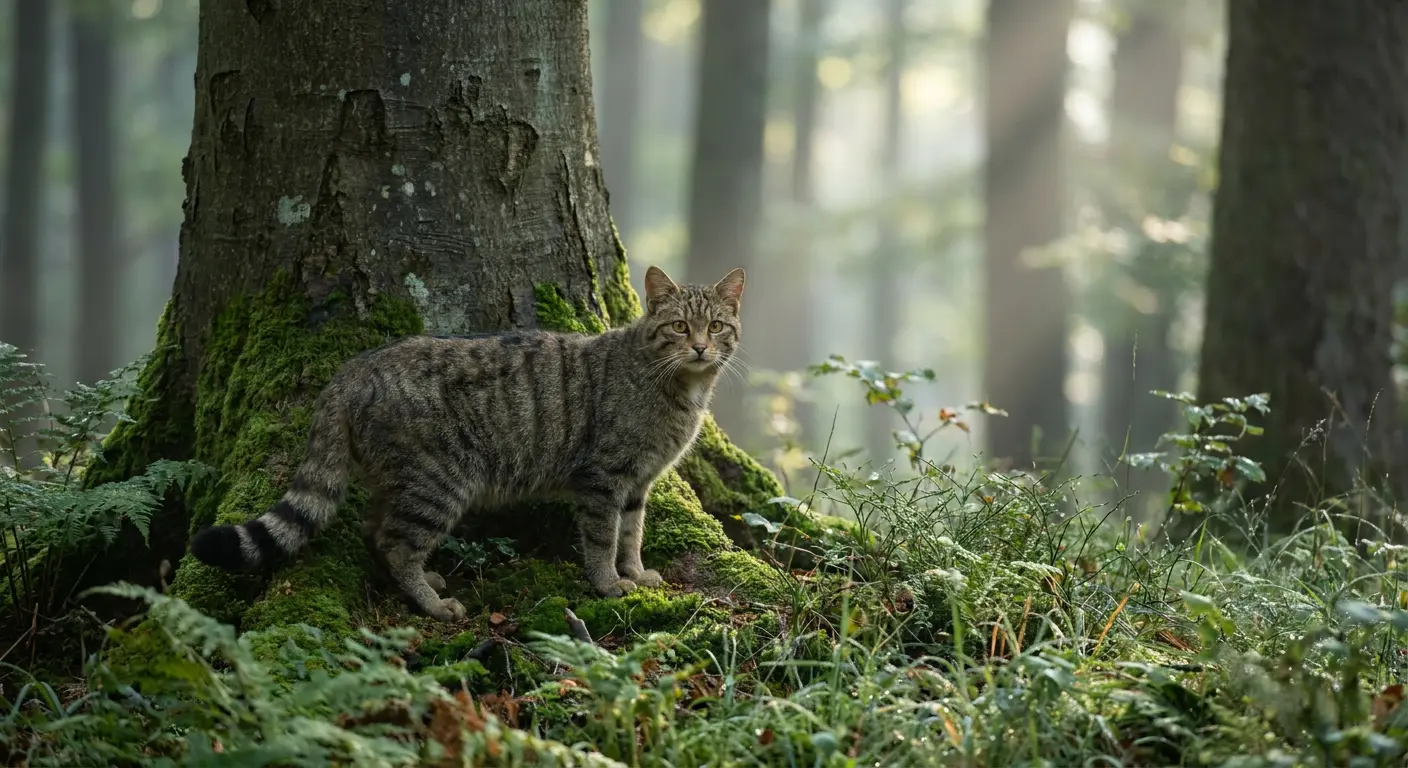
The European wildcat is reclaiming its ancestral territory in the Lusatian Mountains of the Czech Republic, where conservationists recently documented the first recorded presence of the species in nearly a century. A male named Jonáš and a female named Tonka are the faces of this regional revival, with Tonka already producing at least three kittens.
This success strengthens the next generation in the forest.
A Foothold in the Forest
Hidden within the dense canopy of Central Europe, these small predators are easy to miss. The European wildcat, or Felis silvestris, is roughly the size of a large domestic housecat, yet its temperament and lineage remain strictly wild.
For decades, the species was pushed toward the margins of the continent by a combination of habitat loss, human persecution, and the encroachment of domestic feline populations. Now, the tide is turning in specific pockets of the landscape as forests recover and hunting pressure eases.
Jonáš and Tonka represent a meaningful foothold for a species that has long been absent from this specific corner of the Czech Republic. Their arrival is a testament to what happens when habitat protection and legal safeguards align.
Progress in Germany and France suggests that when given space and time, these cats can successfully recolonise former ranges. In Italy, the recovery has been significant enough for authorities to downlist the species nationally, reflecting a healthier population trend compared to the previous century.
The Fragile Reality of Least Concern
The International Union for Conservation of Nature (IUCN) Red List currently classifies the European wildcat as a species of least concern. This broad label can be deceptive, potentially masking the disappearance of the cat at more local levels.
Rhett Ayers Butler, writing for Mongabay, suggests that the European wildcat’s status is less a single narrative and more a collection of distinct local struggles. While the global status appears stable, the reality on the ground varies sharply between borders.
Contrast the success in the Lusatian Mountains with the status of the wildcat in Scotland. In 2018, the species was declared functionally extinct in the wild across the Scottish Highlands.
Conservationists there are now attempting to rebuild a population from scratch, with 46 captive-bred wildcats released into the Cairngorms National Park as part of an intensive reintroduction project. This effort serves as a stark warning of what occurs when conservation attention arrives too late.
Portugal faces a similarly precarious future. With an estimated population of only 100 animals, the numbers there continue to decline.
In southern Spain, fragmented groups of wildcats struggle to survive amidst road networks, disease, and a scarcity of prey. These regional collapses highlight that a species can appear secure at a continental level while being on the verge of vanishing from entire countries.
The Domestic Threat and Road Dangers
Survival in the modern wild requires navigating a gauntlet of human-made obstacles. Road collisions currently stand as the leading cause of recorded deaths for the European wildcat across its range.
As highway networks expand, the risk of vehicle strikes increases, often cutting off breeding populations from one another and preventing the natural expansion seen in the Czech Republic.
Genetic integrity poses a more subtle but equally permanent threat. Hybridisation with domestic cats remains a significant complication for the species.
In certain landscapes, the interbreeding is limited, but in others, it threatens to completely erase the genetic distinction between the wildcat and the common housecat. Managing feral cat populations is now viewed as an essential component of protecting the wildcat's future.
Questions remain regarding the exact hybridisation rates in the newly established Czech population. Without careful monitoring, it is difficult to determine how many cats in these recovering regions remain genetically pure.
The success of Jonáš and Tonka provides a moment of optimism, yet it is tempered by the knowledge that their descendants must survive in an increasingly fragmented world.
A Path Forward for the Wild
Monitoring efforts continue to provide the data necessary to protect these cats before reintroduction becomes the only viable path forward. The recovery seen in Central Europe suggests that the species is resilient when the primary drivers of its decline—hunting and habitat destruction—are reversed.
Connected habitats are the foundation of this progress, allowing young cats to move safely between forests to find mates and new territory.
Evidence from the ground in the Lusatian Mountains shows that the European wildcat is more than a ghost of the past. It is a living, breeding part of the modern ecosystem.
By focusing on feral-cat management and improved road safety, conservationists hope to ensure that the kittens born to Tonka will be the first of many to call these mountains home. The journey of Jonáš and Tonka demonstrates that local recovery is possible when the right conditions are met, transforming a century of absence into a future of presence.
Source
European wildcats reappear in Czech mountains after decades | Mongabay