
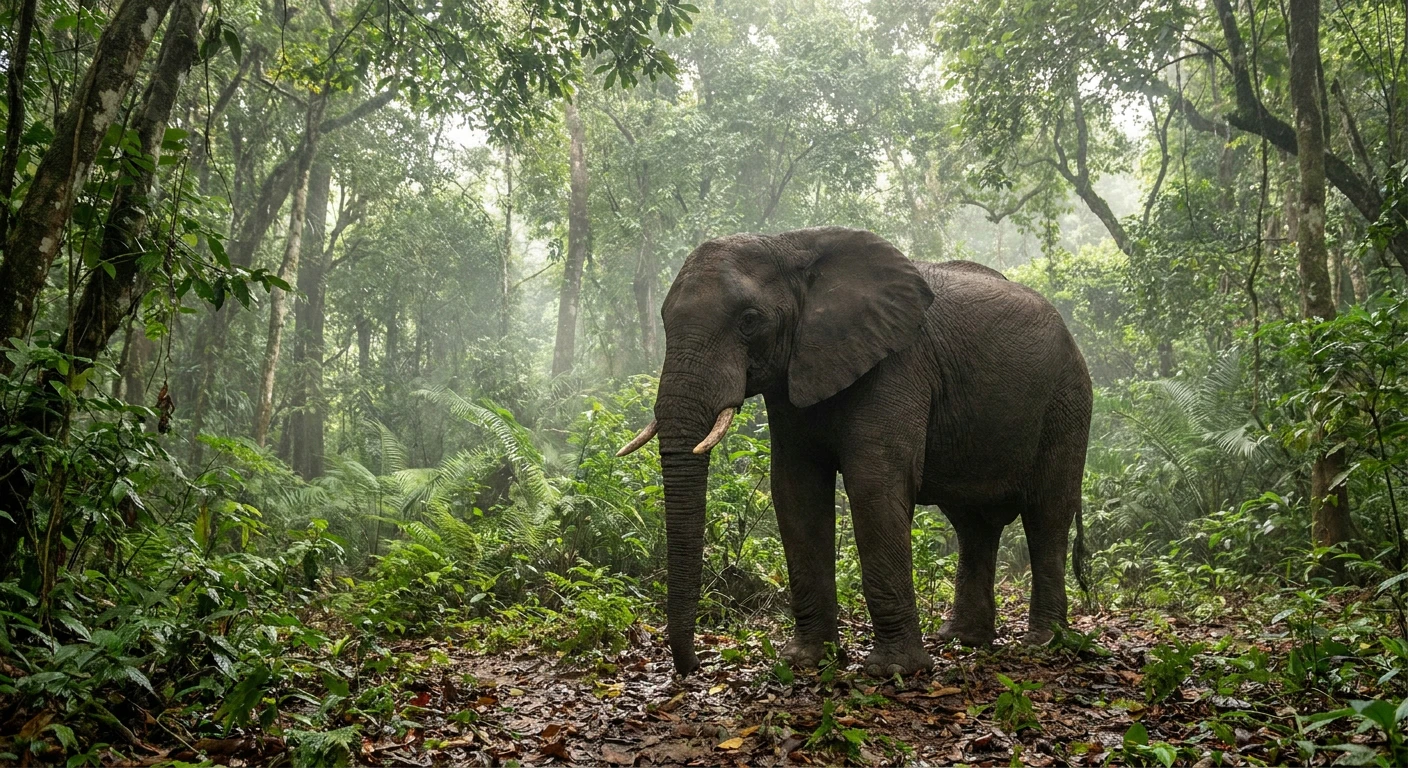
Forest elephants in the Congo Basin and whales across the oceans could help the climate as their populations recover. These large animals hold carbon in their bodies and influence its movement through ecosystems, but those processes do not automatically deliver a predictable reduction in atmospheric carbon dioxide.
Researchers examined elephant and whale studies worldwide in a review published on 19 October 2026 in Current Biology, led by Andrew Abraham of Northern Arizona University. Oswald Schmitz, a professor of population and community ecology at Yale University, who did not participate in the review, agrees that uncertainty needs closer attention. He sees substantial common ground with the authors: wildlife matters, but the size and timing of its climate contribution remain difficult to calculate.
Forest Elephants Change More Than Trees
Seeds carried by forest elephants help the Congo Basin's forests grow and recover. That movement connects an animal's daily life with a much larger carbon store: the region's forests hold an estimated 65 billion metric tonnes of carbon.
Yet seed dispersal tells only part of the story—forest elephants and savanna elephants also damage vegetation, including trees that absorb carbon dioxide, while their feeding and movement reshape the habitats around them.
Less woody vegetation can mean less carbon held above ground. Under some conditions, though, limiting that growth may lower the risk of severe fires that release carbon, so the same animal's activity can pull the accounting in different directions.
Research by Schmitz and other scientists also indicates that animal movement can encourage lasting soil carbon storage under suitable conditions. The number of animals present helps determine the outcome, making a universal carbon label for an elephant difficult to defend.
A forest elephant is not simply a carbon sink with legs. Its influence changes with its surroundings, and measuring that influence means looking beyond the carbon contained in its body to the forest and soil it helps shape.
The case for recovery does not depend on resolving every calculation first. Research cited in the review indicates losses of about 70% among Africa's savanna elephants and a likely 90% among forest elephants, with hunting and habitat loss driving declines.
Whales Carry Carbon Beyond Their Bodies
A whale's nutrient-rich waste supports phytoplankton, the microscopic organisms that take up carbon dioxide. Known as the 'whale pump', that connection helps explain why researchers look beyond an animal's size when considering its influence on ocean carbon.
Living whales also retain carbon in their bodies over lifetimes that can span decades or longer. After death, some sink into deep water, where organisms feeding on their remains keep that carbon away from the atmosphere.
Those mechanisms offer real reasons to investigate recovery as part of climate action. Centuries of hunting reduced many whale populations, raising the possibility that their return could restore carbon processes alongside the animals themselves.
Whales and elephants also release carbon through breathing and digestion. Scientists cannot yet confidently assign a particular species in a particular ecosystem a fixed amount of additional carbon capture and storage.
Recognising a process is different from measuring a dependable climate benefit. For conservation, that leaves room for research without making the animal's protection conditional on a carbon total.
Recovery Comes Before Carbon Accounting
To start restoring whales and forest elephants, efforts need to focus on addressing declining populations first, as their effects on carbon vary with habitat, species and time, says Abraham. Investing in wildlife recovery specifically for climate returns as "high-risk" and have concerns centred on uncertain calculations, particularly when those calculations underpin carbon credits or offsets.
Establishing climate contribution requires longer observation, better experiments and an honest account of uncertainty, rather than promises that might later weaken confidence in conservation. The distinction matters for conservation funding and climate action alike.
Ethan Duvall, a co-author and executive director of the Amazon Research and Conservation Collaborative, wants funding to reach wildlife conservation. His caution is not an argument against restoring elephants or whales—but the reasons offered for that investment and whether the evidence can support them.
The researchers also draw a line between the pace of animal recovery and the need to cut emissions. Rebuilding populations of long-lived species, and allowing their ecological effects to develop, cannot replace the immediate work of moving away from fossil fuels.
Carbon Prices Need Firmer Evidence
A 2020 report led by Ralph Chami of the International Monetary Fund gives that uncertainty a financial dimension: they assigned a $1.75 million valuation for a forest elephant while they estimated $2 million for a whale.
Schmitz, who was not involved in the valuation report, sees such figures as an attempt to make animals' economic contributions visible.
The risk extends beyond an inaccurate price. Funding tied to carbon could encourage wildlife managers to favour a carbon outcome over the health of the wider ecosystem, while benefits that fail to materialise could damage trust in restoration.
A stronger approach would test how different animal densities affect carbon and follow those effects for long enough to understand them.
The review's authors judge that animal restoration is unlikely to expand enough to make a meaningful contribution towards net-zero emissions by 2050. Schmitz nevertheless points to research suggesting that sustained elephant recovery may stabilise carbon processes over decades.
Instead of a choice between wildlife and climate, this leaves a practical route forward: restore populations to address species loss, measure their carbon effects carefully, and let the evidence determine which climate claims can follow.
Abraham, Duvall and Schmitz were among more than 350 experts involved in a June 2026 scientific consensus effort on wildlife and climate.
Source
Large animals are living carbon stores. Does that make saving them a climate solution? | Mongabay