In Mexico’s highlands and across agave country, the lesser long-nosed bat plays a vital ecological role in keeping tequila production alive, while conservationist Rodrigo Medellín helped bring the species back by persuading the industry to protect the plants it depends on.
The solution was simple but difficult to implement: allow some agave to flower, maintain pollination, and restore the bats’ food source, reversing years of decline driven by farmers cutting plants before bloom to increase sugar content and yield.
The Bat That Keeps the Bottles Full
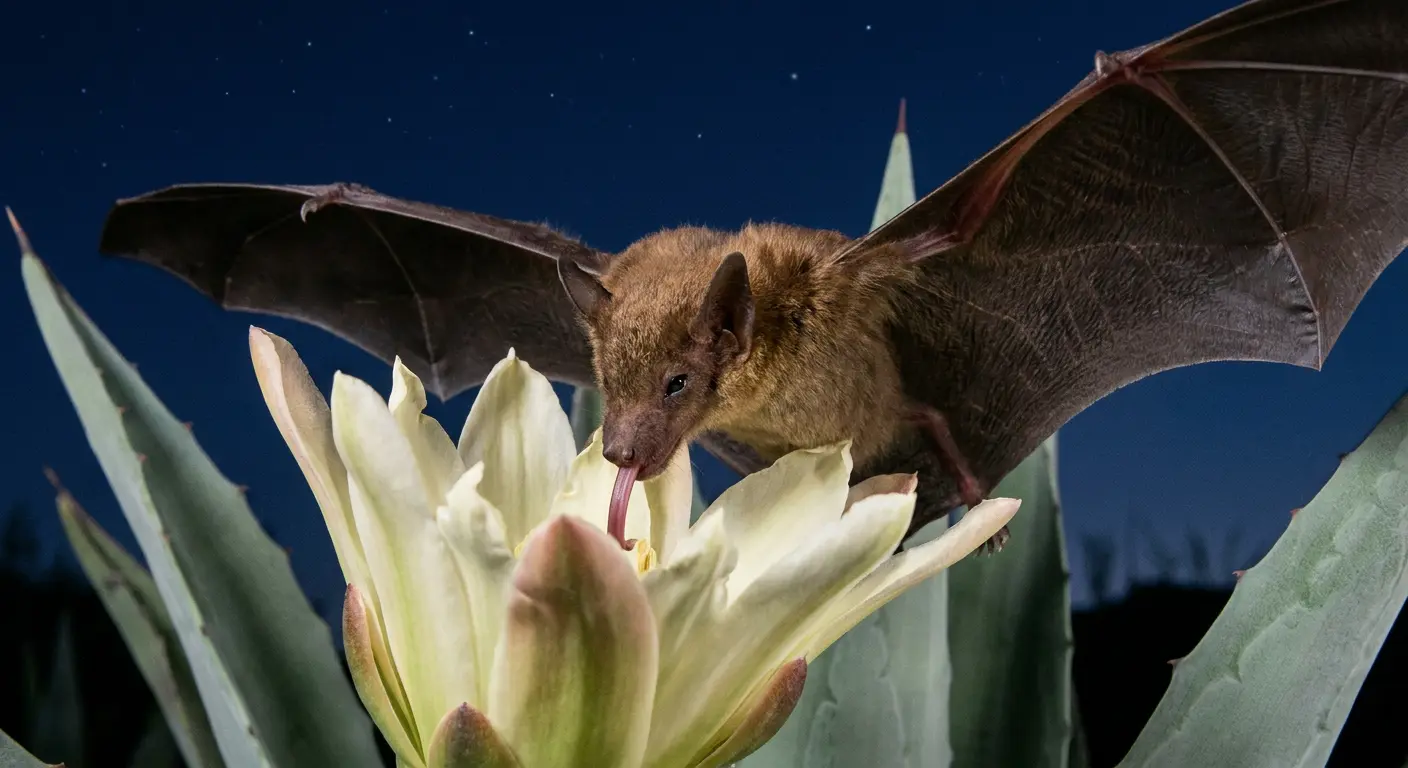
Every shot of tequila starts with a bat. Lesser long-nosed bats, Leptonycteris yerbabuenae, move through agave flowers at night, carrying pollen from plant to plant and making seed set possible.
No seed set means wild agave populations weaken. Lose the agave, and the chain reaches straight to tequila, mezcal, and the wider dry country where these plants grow. That is the link Medellin understood long before many growers did—by 1994, when the species was listed as threatened, he had already studied the bat and the effects of lost agave flowering.
A Scientist Who Spoke Agave
Medellin's attachment to bats began early. He was 13 in 1970 when he held his first bat, a moment he later described as the point when his curiosity was sealed for life.
He went on to become Senior Professor of Ecology at the Institute of Ecology at UNAM, Mexico's National Autonomous University, and a National Geographic Explorer-at-Large, the first person from outside the United States or Europe to hold that title. He also co-chairs the IUCN Bat Specialist Group, founded the Program for the Conservation of Bats of Mexico, and created RELCOM (Red Latinoamericana y del Caribe para la Conservación de los Murciélagos), the Latin American Network for Bat Conservation, which now spans 23 countries.
That kind of reach mattered, but the breakthrough came from translation. Medellin did not begin by selling bat rescue to growers. He talked about agave, flowering fields, and what happens when bats and other pollinators return in numbers not seen in decades.
"They're full of food and bats are visiting—it's nothing short of historic," he said later. "This is the way things were done six generations ago."
Making the Industry a Partner
Working with David Suro of the Tequila Interchange Project, Medellin helped create Bat Friendly™ certification, a label for tequila and mezcal producers who commit to sustainable agave farming practices that allow pollination to happen. The idea was simple and sharp: make bat-friendly farming valuable in the market.
That shift changed the tone in the field. Farmers who left a portion of their agave to flower saw bats return, and the old relationship between plant and pollinator started to rebuild itself.
The change was not instant, and the story still carries uncertainty, as each field and season faces different pressures. Yet the direction is clear: what began as a niche idea is now moving toward industry standard.
A Bat on the Return from the Brink
The results came in the numbers and the status changes. The lesser long-nosed bat was removed from Mexico's endangered species list in 2015. Three years later, the United States followed, making it the first bat species ever delisted from the U.S. Endangered Species Act.
Populations that had crashed over more than half a century were rising again. Medellin has described the outcome less as a triumph than as a return to what was already there, a restoration of a working system that had been interrupted.
He frames bats as part of everyday life, not a side note to conservation. "Every day of our lives is touched by one or more ecosystem service that bats provide," he said. "From your cotton shirt to your coffee to your tacos to your rice to your tequila, and much, much more, your life has been touched by bats."
The bat was never just a symbol. It was a working partner in the agave economy, and the economy finally began to recognise the debt.
The Man Behind the Turnaround
Medellin's public profile grew with the work. In 2014, BBC Natural World made a documentary about him, narrated by David Attenborough. He also won the Whitley Award twice, including the inaugural Whitley Gold Award in 2012, the first person in the award's history to receive it more than once.
Now in his late sixties, he still sounds like the child who first held a bat and never quite got over it. "Inside I continue to be that 13-year-old child every time I see a bat!", he said.
The story of the lesser long-nosed bat is of a field-tested case of recovery and a biologist who understood that tequila would be stronger if the bats stayed in the story.
Source
Rodrigo Medellín: Becoming the 'Bat Man' of Mexico | National Geographic