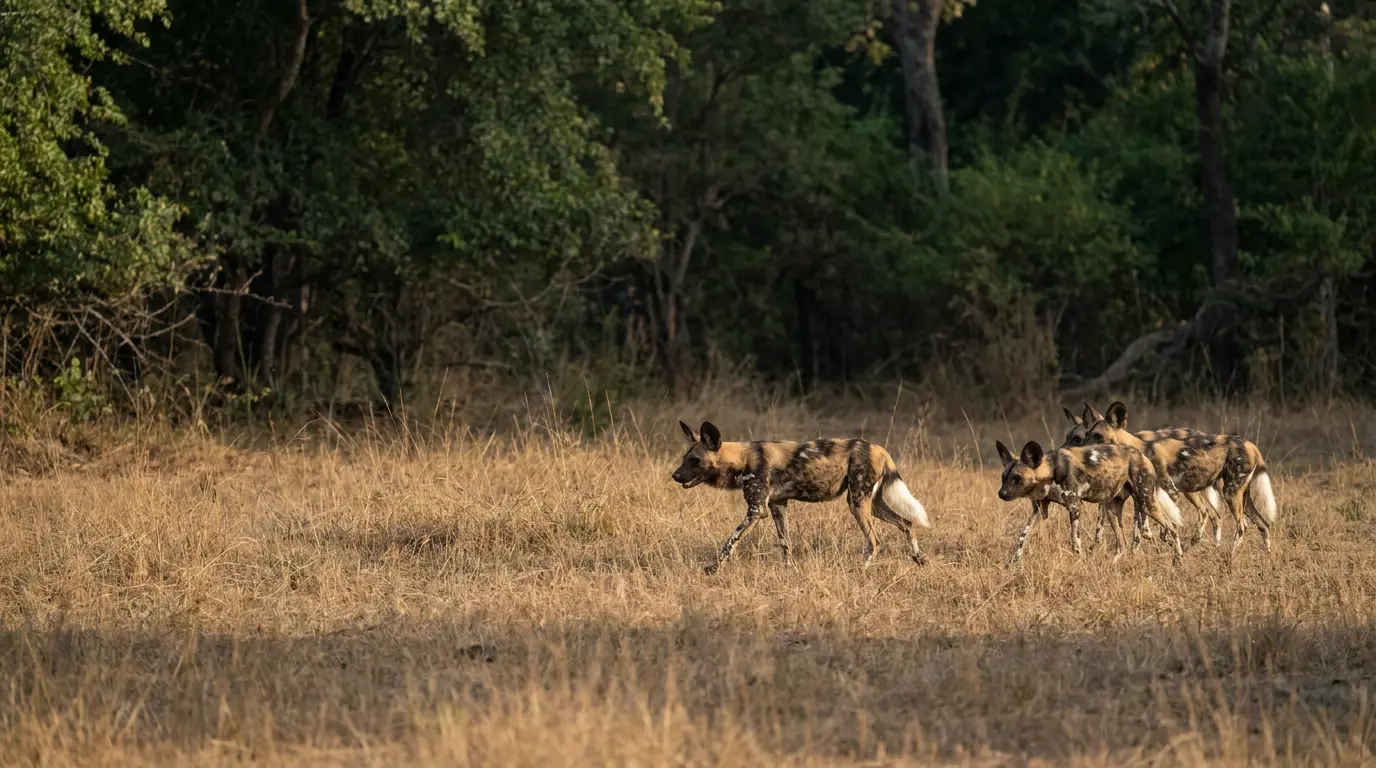
African wild dogs, western chimpanzees, lions and Derby elands are gaining stronger protection in Senegal's Niokolo-Koba National Park, where rangers, scientists and local communities are expanding a recovery effort in 2026. Following a US$1.26 million Global Environment Facility approval in June, IUCN and Senegal's Directorate of National Parks are restoring habitat, improving management and supporting livelihoods because lasting wildlife recovery across this nearly one-million-hectare refuge depends on people having the tools and economic room to protect it.
Niokolo-Koba holds the last wild population of African wild dogs in West Africa. Along the Gambia River, its savannahs, forests, rivers and wetlands also shelter elephants, leopards, buffalo, roan antelope, hartebeest, reptiles, amphibians and a rich spread of birdlife.
The park enters this new phase with real momentum. Senegal's work with IUCN Members and Commission Experts helped remove it from the List of World Heritage in Danger in 2024, while stronger patrols and camera-trap records now offer measurable signs that several wildlife populations are stabilising or growing.
Rangers Turn Footwork Into Evidence
More than 400 camera traps went into the park in 2024. Teams from the Directorate of National Parks, Panthera and the Zoological Society of London walked nearly 2,000 kilometres in difficult conditions to deploy them, completing one of the largest wildlife monitoring surveys conducted in an African protected area.
The cameras are recording where mammals live and providing information about their abundance. At the same time, survey teams are gathering evidence of illegal activity and other pressures, giving park staff a clearer basis for deciding where patrols and management responses should go.
That shift matters. Park managers previously often relied on outside assistance for ecological information, while the BIOPAMA programme, jointly run by IUCN and the European Commission's Joint Research Centre with European Union funding, has equipped Directorate staff with standard methods, training and field tools.
Knowledge now sits closer to the ground. Rangers and managers can build long-term records themselves, compare results and adapt their work as conditions change rather than waiting for an occasional external assessment.
Patrols covered almost half the park in 2025, supported by an increased ranger presence. Systematic camera surveys recorded positive trends among buffalo, roan antelope, hartebeest, lions and wild dogs, evidence that stronger protection is beginning to register in the lives of animals.
Progress, With the Warning Lights On
A lion caught by a camera trap is an encouraging image, not a declaration that the work is finished. The 2025 IUCN World Heritage Outlook rated Niokolo-Koba's conservation outlook as "significant concern", an improvement from the "critical" assessments issued in 2014, 2017 and 2020.
The assessment identified work still needed on poaching, illegal resource use, invasive species and fire management. Mining, agricultural expansion and governance within the park and nearby community-managed areas add further pressure.
Some questions remain open. Camera records can reveal a positive direction, yet the source does not provide population totals for most recovering species or establish how evenly gains extend across the park's vast interior.
Honest recovery allows for that uncertainty. Better monitoring does not merely produce reassuring pictures; it helps rangers find weak spots, track change and direct limited resources towards animals and habitats under the greatest strain.
Wild Dogs and Chimpanzees Get Focused Support
African wild dogs carry unusual weight here. Since Niokolo-Koba contains West Africa's last remaining wild population, every pack contributes to the species' future across an entire region.
A Save Our Species project implemented by the Zoological Society of London is combining camera traps with genetic analysis of faecal samples to study the dogs' distribution and threats. GPS tracking may also be used, while the findings feed into a National Action Plan for the species in Senegal.
Disease, damaged habitat and conflict between people and wildlife remain part of the equation. Community outreach sits alongside field research because tracking a pack answers only one side of the problem; people living near its range also shape whether the dogs have space to persist.
Western chimpanzees face a different set of pressures. IUCN moved the subspecies from "Endangered" to "Critically Endangered" in 2016, and teams recorded 178 chimpanzee nests in Niokolo-Koba during 2024, with about 40 adults known.
De-snaring work aims to make the forest safer for those chimpanzees. A project led by the Zoological Society of London and the UK Darwin Initiative also supports more varied local livelihoods and stronger veterinary capacity to address rabies and respond when animals encounter snares.
The IUCN Species Survival Commission's great ape specialists contribute through a regional action plan for 2020 to 2030 and the A.P.E.S. Database. Together, those efforts connect individual nests and snare sites to a wider plan for western chimpanzee recovery.
Recovery Reaches Beyond the Park
Nearly 30,000 square kilometres connect Niokolo-Koba with the wider Niokolo-Badiar Dulombi-Boe complex across Senegal, Guinea and Guinea-Bissau. Wildlife does not recognise a park boundary, so degraded habitat, invasive plants and human pressure outside protected ground can erode gains made inside it.
IUCN is leading 11 partners under the European Union-funded Integrated Programme for Conservation, Economic Valorisation and Resilience. The programme works on institutions, sustainable value chains and cooperation across borders, with the aim of improving livelihoods for around 250,000 people while supporting ecosystem protection.
Community income is not a side project here. Conservation holds longer when nearby residents can meet daily needs without exhausting forests, wetlands or wildlife, and when they have a voice in decisions that shape access to natural resources.
The newly approved GEF-8 project makes that connection explicit. Implemented by IUCN and executed by Senegal's Directorate of National Parks, it is expected to benefit about 2,000 people directly, including 1,500 women.
US$1.26 million will support the restoration of 3,000 hectares of degraded ecosystems and improved management across nearly 913,000 hectares of protected areas. The project also plans to promote sustainable practices over 5,000 hectares around those protected lands while developing ecological monitoring, local livelihoods and participatory governance.
Those figures describe scale, not guaranteed outcomes. Whether restored ground holds, economic opportunities endure and wildlife continues to recover will depend on follow-through by public agencies, field teams and communities long after the first funding cycle.
A Park Built Through Partnership
Niokolo-Koba's recovery rests on overlapping work rather than a single dramatic intervention. Rangers patrol, scientists read camera data, veterinarians prepare for disease and snare cases, while residents help shape how conservation and local economies meet.
The park's 2024 removal from the danger list marked progress earned over years. Its 2025 assessment kept the tougher truth in view: poaching, habitat degradation, invasive plants, fire and development pressure have not disappeared.
Nearly one million hectares leave plenty unseen. A camera may catch a wild dog crossing at night, then record nothing for weeks; a chimpanzee nest confirms presence, while leaving the animal itself somewhere beyond the frame.
That patient accumulation of signs is how recovery becomes credible. The next phase gives Senegalese park staff and their partners more capacity to turn tracks, nests, patrol reports and community knowledge into decisions that animals can feel on the ground.
For Niokolo-Koba, the forward path is practical: keep rangers in the field, restore damaged habitat and make nearby livelihoods part of the response. IUCN's account of the park's recovery programme shows a refuge moving in the right direction without pretending the hard work is over.
Source: Read the original article