
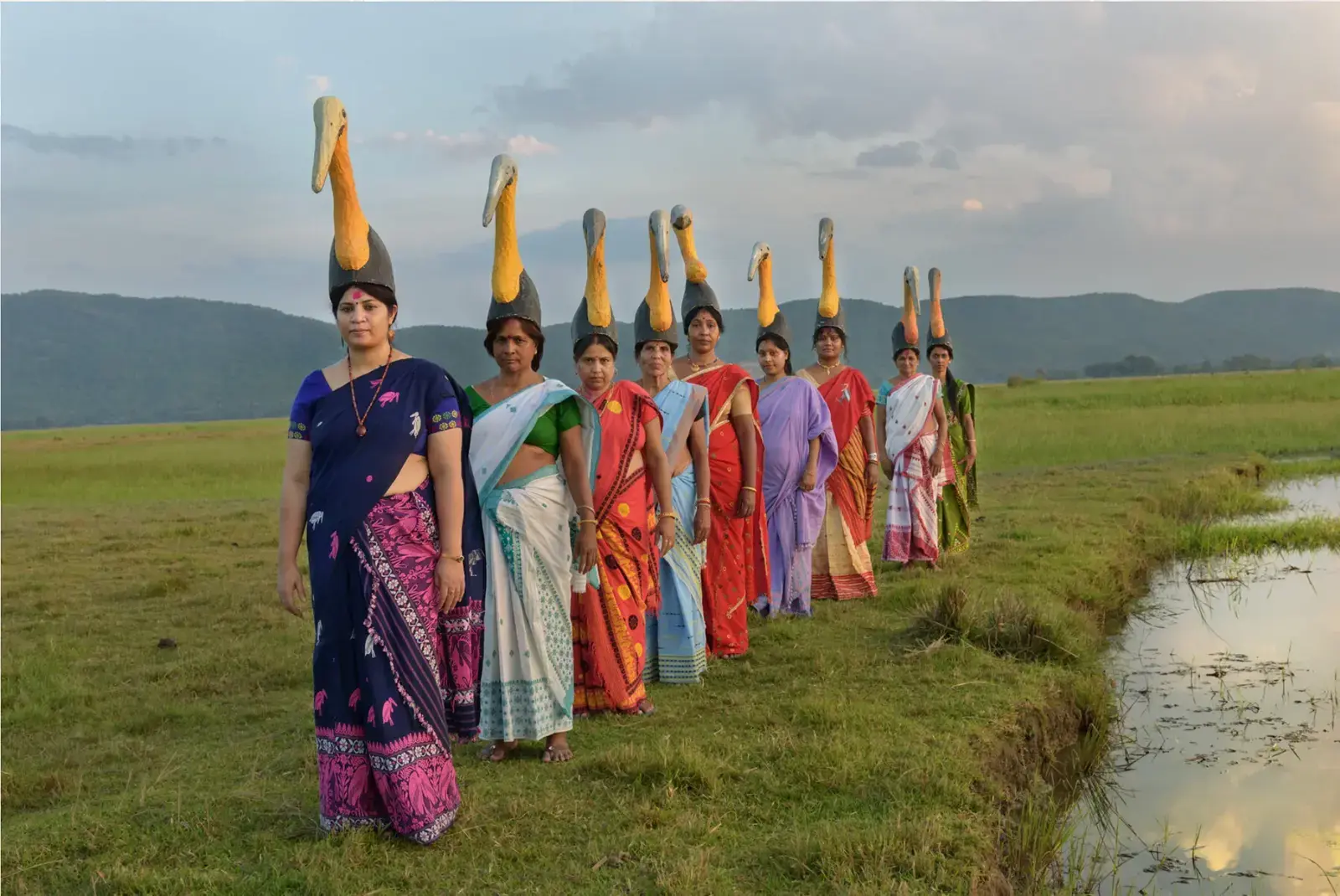
The greater adjutant stork nests again in the palms and paddy-edge trees of Assam, in northeast India, where women in bright traditional dress have turned a once-scorned scavenger into a source of pride, income, and daily care. In Kamrup district, Dr Purnima Devi Barman and a 20,000-strong, women-led collective known as the Hargila Army have helped push the bird back from the brink, with the world's largest breeding colony now spread across the villages of Dadara, Pachariya, and Singimari.
That change took years, not slogans. It came through village work, weaving looms, baby-shower rituals for nesting storks, injured chicks pulled from monsoon nets, and a simple shared question: what would make this bird worth keeping alive?
From Bad Luck to Belonging
The greater adjutant stork (Leptoptilos dubius), known locally as hargila, or "bone swallower," once had a grim reputation in these villages. People hated its smell, blamed it for bad luck, and cut down the tall trees it nested in rather than live beneath it. By the 1990s the species, once so prominent it featured on colonial Calcutta's coat of arms, had all but vanished from the landscape.
Today those same villages host the world's largest breeding colony of greater adjutant storks. Nest numbers in Kamrup district have climbed from 27 in 2008 to more than 210, and the area is now recognised as an Important Bird Area. The bird turns up in folk songs, on woven textiles, and at the baby showers the community holds for new chicks.
The Work in Practice
Barman understood early that enforcement alone would not save the hargila. The storks nested in privately owned trees, which meant every tree owner had the right to cut one down, and many did. As a PhD student in 2007, her research showed the species near oblivion, with only 800 to 1,200 adult birds left worldwide at the time. She put her doctorate on hold to spend years in the villages instead.
The answer came through culture rather than rules. Wedding songs, prayers, baby-shower ceremonies for nesting storks, and weaving looms gave the conservation message a local shape, and that shape made people care. Barman began the Hargila Army in 2008 with around 400 women.
Women on the Front Line
The Hargila Army now numbers about 20,000 women. They guard nesting trees, catch fallen chicks in nets strung beneath the branches during monsoon storms, and return rescued nestlings to the colony. They also weave the stork's distinctive silhouette into traditional mekhala chadors and gamochas, sold through the group's own retail platform, so a bird once seen as a curse now helps support households.
That economic shift is part of the conservation result. When a wild animal helps feed a family, protection stops being abstract. It becomes practical, personal, and hard to undo.
A Species Still Dependent on Care
The effort is working, and the numbers show it. In 2023 the IUCN moved the greater adjutant stork from "endangered" to the less severe "near threatened," and the global population is now estimated at at least 3,180 birds, with roughly 1,830 in Assam, 600 in Bihar, and 750 in Cambodia. Even so, the species remains entirely conservation dependent, with only 1,360 to 1,510 mature individuals, and the IUCN warns that any drop in protection could reverse the gains.
Barman's work has been widely recognised. She has received the Whitley Award and, in 2024, the Whitley Gold Award, along with the UN Champions of the Earth prize and India's Nari Shakti Puraskar; in 2025 Time named her one of its Women of the Year. She plans to grow the Hargila Army by another 10,000 women and lift the stork's numbers toward 5,000 by 2030, expanding into Bihar and Cambodia.
None of that recognition came from a lab or a boardroom. It came beside paddy fields and nesting trees, in conversations with women whose knowledge had once been dismissed and then proved indispensable.
Source: Reasons to be Cheerful. Read the original: https://reasonstobecheerful.world/stork-sisters-saving-a-species-on-the-brink/