
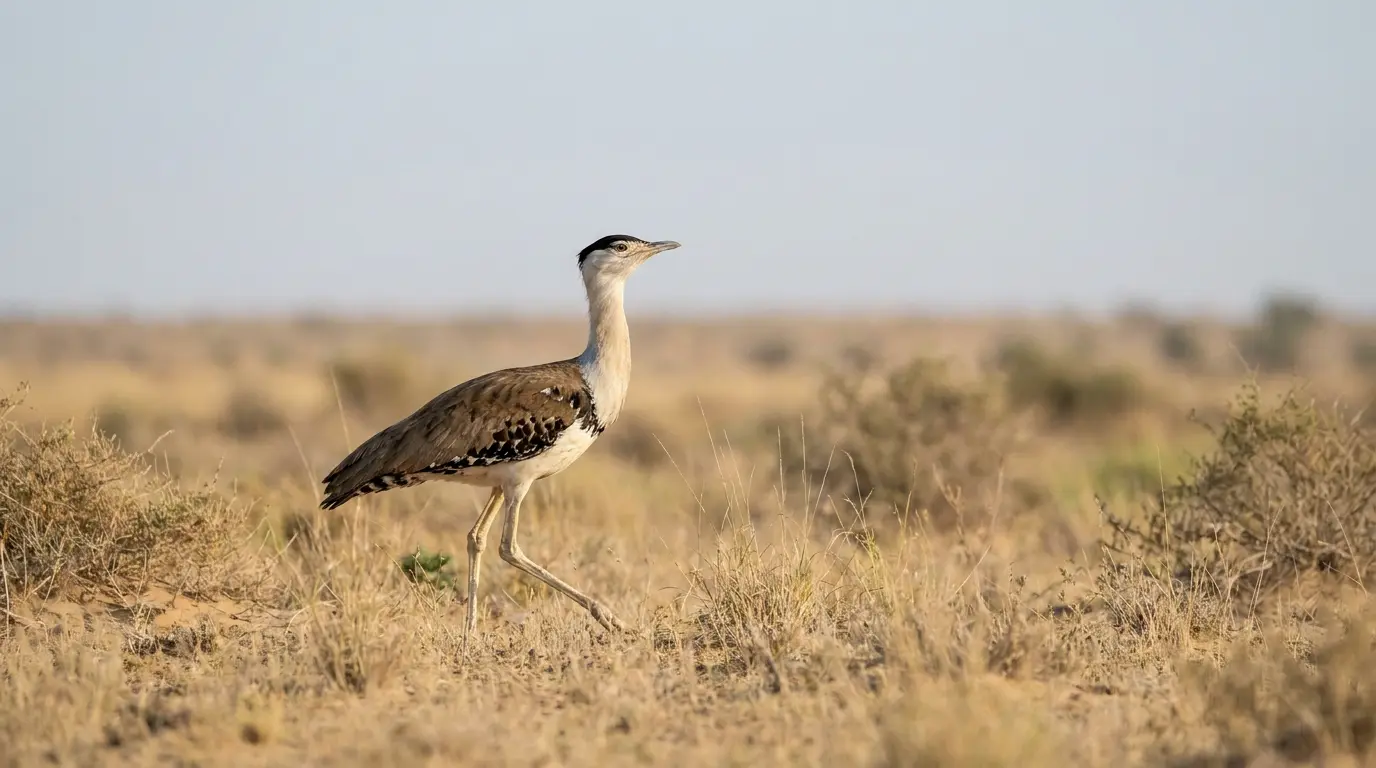
2 male great Indian bustards began Project GIB's first rewilding step on 4 October 2026, when Environment Minister Bhupender Yadav and Wildlife Institute of India scientists released them in Rajasthan's Desert National Park. Raised through conservation breeding in Jaisalmer, the bustards now take a programme designed to rebuild their depleted wild population beyond the breeding centres and into their natural habitat.
About 150 bustards survive in the wild. The release marks tangible progress, though the available reporting does not yet establish how the 2 males are adapting or whether they will breed.
Release Begins the Learning
The environment ministry says the birds will help scientists refine methods for future reintroductions. Release is a beginning, not evidence of lasting recovery: what researchers learn from these males should inform how later birds make the transition.
11 birds were selected for eventual release, with these males forming the first group. The source gives no timetable for the remaining birds, leaving the pace of the next phase open.
Grassland Supports the Return
Around 200 square kilometres of grassland sit within fenced enclosures established by Rajasthan's forest department inside the park. Wildlife Institute of India researchers used long-running telemetry studies to identify these areas as strong breeding habitat for bustards, connecting the breeding programme with habitat restoration.
Ramdevra and Sam, both in Jaisalmer, house the breeding centres behind the release. Beginning in 2019, staff artificially incubated eggs collected from wild birds and reared the chicks by hand; those birds later reproduced in captivity.
The facilities reported 98 captive-bred birds, with around 86 retained for reproduction. Breeding produced 24 live chicks during 2025 and another 29 during 2026, building a population that can support further releases as scientists refine their approach.
Source
Two captive-bred great Indian bustards released in Rajasthan national park | The Indian Express