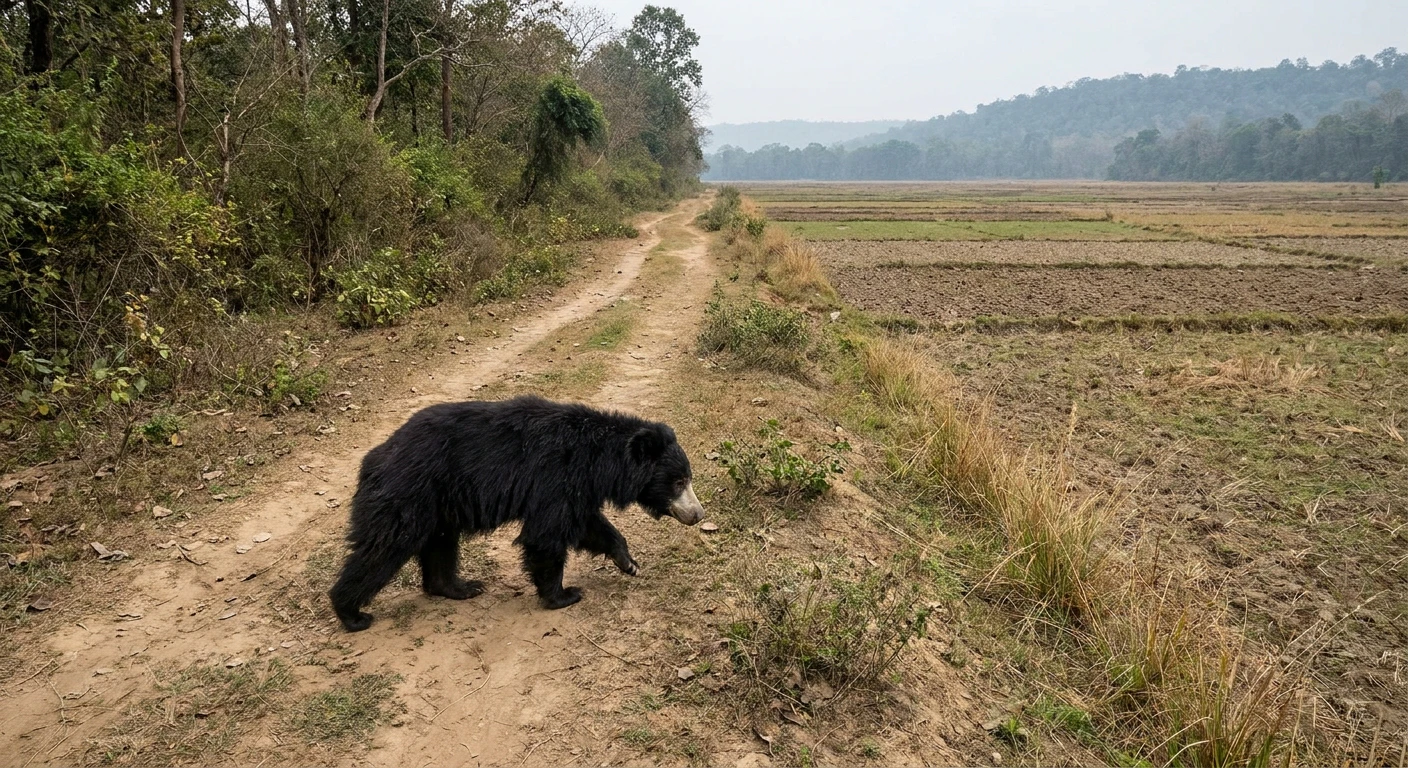
Sloth bears in India's Central Terai now have a first regional genetic baseline, giving conservation planning evidence that reaches beyond protected-area borders. By analysing DNA from bear droppings, researchers identified genetic divisions that do not neatly match those boundaries, helping explain how fragmented habitat affects connections between populations.
The findings point to agriculture as the strongest detected barrier to genetic exchange—and also reveal low genetic diversity, making continued genetic monitoring a practical next step for this human-dominated, multi-use region.
Bear Genetics Cross Park Borders
Four genetic clusters emerged from the analysis across the sampled protected areas. Their geographical pattern did not precisely correspond with the boundaries drawn around those areas, a distinction that matters for how conservationists assess isolation.
A protected-area map and a genetic map answer different questions. The first marks administrative boundaries; the second reveals patterns of biological connection and separation that need not follow them.
For sloth bears, the planning implication reaches beyond individual reserves. Assessing each protected population in isolation could miss relationships across the wider region, where human land use also shapes genetic connectivity.
Those relationships require careful interpretation. The researchers suggest that past population structure and present-day habitat fragmentation may both have shaped the genetic patterns they detected, rather than attributing everything to current land use.
How much belongs to the past, and how much reflects fragmentation today? That distinction remains unresolved, and it matters when deciding what present-day conservation action can change.
Agriculture Shapes Genetic Connection
Agricultural land ranked first among the detected barriers to gene flow, followed by proximity to water. The finding gives conservationists a specific land-use factor to examine. Proximity to water also calls for restraint in interpretation. Its position in the analysis does not justify a blanket claim that rivers block sloth bears, or that all waterside habitat has the same effect.
The distinction is practical: planning for bear connectivity needs to consider the land's character, not simply the distance separating protected habitats. Rather than a direct record of individual bears crossing particular fields, genetic exchange is the focus, and the analysis connects genetic patterns with environmental features.
The response begins with an evidence-led assessment of connections across the wider Central Terai. Agriculture's prominence makes it a clear priority for that work, while the influence of historical population structure argues against a single-cause explanation.
Droppings Reveal Genetic Diversity
209 faecal samples provided the starting material for identifying 66 individual bears. Researchers collected the samples non-invasively, so they could build a genetic picture without capturing the animals for sampling.
Using DNA sequencing, the team examined genetic markers across the bears' genomes. These markers supported individual identification and analysing genetic differences across the sampled populations.
Across the genetic clusters, the researchers found low genetic diversity, meaning there is limited variation in the bears' DNA.
The team also found that bears carried matching gene variants more often than expected. Read together, the results warrant attention to genetic condition alongside the distribution of bears across protected areas, as habitat fragmentation can reduce genetic diversity and raise inbreeding risk. These factors can potentially contribute to local extinction, but these measurements do not establish an extinction deadline for the sampled bears.
Continued genetic monitoring will help provide clearer answers, where future assessments can be built on a measured starting point.
A Baseline Built for Follow-Up
Despite laboratory and data-analysis challenges, non-invasive sampling provided new genetic insights into this little-studied species. This methodological progress matters alongside the findings on agriculture and diversity: researchers have demonstrated an approach that can support further investigation.
The corresponding author, Divyashree Rana, has archived the analysis code and processed genetic data in a GitHub repository. Raw sequence data are also stored in the Indian Nucleotide Data Archive, hosted by the Indian Biological Data Centre.
These archived samples provide a starting point for future research. For sloth bears in the wild, the next task is to turn this first regional genetic picture into sustained monitoring and better-informed decisions about the land connecting their habitats.
Source